The difference
The difference between CWB certification and TSSA certification lies in their specific focus and regulatory requirements:
CWB Certification (Canadian Welding Bureau)

- Scope: The CWB certification primarily focuses on structural welding. It is a national certification required for welders working on structures that fall under CSA (Canadian Standards Association) standards, such as buildings, bridges, and other steel structures.
- Regulatory Focus: The CWB certification ensures that welders are qualified to perform structural welding according to CSA standards (such as W47.1, which governs fusion welding of steel, and W47.2, which governs fusion of aluminum). CWB certification is essential for welders working in the construction, fabrication, and other structural steel projects where adherence to national safety and quality standards is critical.
- Testing and Qualification: CWB tests are typically conducted on specific materials and weld positions that align with the structural requirements. Welders must demonstrate their ability to meet the standards for joint configurations and welding positions related to structural components.
Learn more about itt’s cwb testing
TSSA Certification (Technical Standards and Safety Authority)
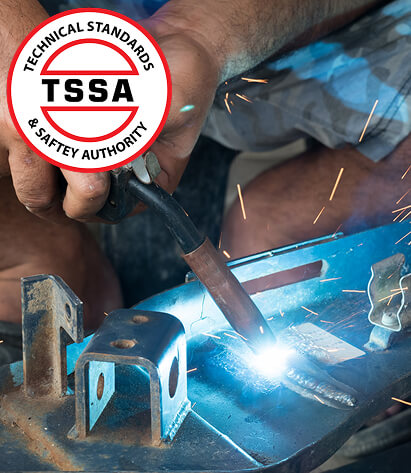
- Scope: The TSSA certification focuses on pressure welding, including welds on pressure vessels, boilers, pipelines, and other high-pressure systems. It is specific to industries where the safety of pressure-retaining components is a concern, such as oil and gas, power generation, and manufacturing.
- Regulatory Focus: TSSA certification ensures compliance with Ontario’s provincial safety regulations and national codes, such as the ASME (American Society of Mechanical Engineers) Boiler and Pressure Vessel Code and CSA B51, which governs the construction of pressure vessels. TSSA certification is essential for welders working on pressure systems, where weld quality directly affects safety.
- Testing and Qualification: TSSA certification tests typically involve more rigorous standards for welding on pressure systems, including material thickness, weld strength, and defect tolerance. Welders are tested on specific materials and joint configurations that are critical for maintaining pressure integrity.
Learn more about itt’s tssa testing
Summary
CWB Certification focuses on structural welding (buildings, bridges, steel structures), while TSSA Certification is centered around pressure welding (pressure vessels, boilers, pipelines).
CWB Certification is necessary for welders working on structural projects that adhere to CSA standards, whereas TSSA Certification is required for welders working on systems that must comply with safety codes governing pressure-retaining components.
